Practice Tips
Nov 11, 2025
7 Mistakes to Avoid on the SAT (and What to Do Instead)
Why Avoiding SAT Mistakes Can Raise Your Score Faster Than Studying More
You’ve been studying for weeks, maybe months, but your SAT score still isn’t improving. Many students spend endless hours memorizing vocabulary, equations, and grammar rules but overlook the most powerful way to boost their score — avoiding the mistakes that cost points.
The SAT doesn’t just test what you know. It measures how you think, manage time, and handle pressure. Learning to recognize and prevent common pitfalls can help you raise your score faster than studying more content.
If you’re preparing for the new Digital SAT, Curio can help. It creates personalized SAT-style quizzes based on your Learning Profile, tracks your progress, and adapts difficulty as you improve.
Let’s go through the seven most common mistakes SAT takers make, and how you can avoid each one.
1. Mismanaging Time
Time management can make or break your SAT score. Many students spend too long on one question and end up rushing the final section.
To fix this, practice with a timer and aim for a steady rhythm rather than perfection. For instance, if you find yourself stuck on a hard math problem after two minutes, skip it temporarily and move on to secure easier points first. Know your pacing limits and skip questions that take too long. The SAT rewards smart strategy, not stubbornness.
2. Skipping Full-Length Practice Tests
Short quizzes are useful, but they can’t prepare you for the focus required on test day. The SAT is long and mentally demanding, so you need to train your stamina.
Take at least three full-length practice tests under real conditions using a laptop or tablet. For example, simulate test day by sitting in a quiet room at the same time as the real test and refrain from using breaks for phone or snack distractions. Simulating the digital environment helps you manage fatigue and discover where your concentration drops.
3. Ignoring Error Patterns
One of the biggest SAT mistakes is failing to analyze why you miss questions. Many students simply check their score and move on, repeating the same errors week after week.
Keep a simple mistake log: write down what went wrong and why. For example, after a practice session, note if errors were mostly careless slips (misreading a question), conceptual misunderstandings, or timing issues. Review it weekly. Seeing that most of your errors are careless might prompt you to slow down, whereas conceptual errors might require targeted review.
4. Not Adapting to the Digital Format
The Digital SAT is shorter, adaptive, and entirely computer-based, which means you’ll need to get comfortable working on-screen. Students who prepare only with paper tests often find the real interface distracting or unfamiliar.
Practice on your actual device and use the official College Board Bluebook App. For example, familiarize yourself with digital tools like the highlighting feature and calculator function to reduce fumbling during the test. The more natural the test environment feels, the less stress you’ll have on exam day.
5. Guessing Poorly
Because there’s no penalty for wrong answers, leaving a question blank always hurts your score more than guessing. Train yourself to make confident, educated guesses. Eliminate wrong choices quickly, trust your instincts, and commit to an answer instead of hesitating.
At this stage, consistency and feedback matter more than perfection. Midway through your prep, it’s smart to review your process using adaptive study tools such as Curio, which tracks your answers, analyzes your mistakes, and helps you strengthen your reasoning skills over time.
6. Focusing Only on Weak Topics
It’s easy to over-focus on your weaknesses and forget to maintain your strengths. For example, if you are strong in algebra but weaker in data analysis, start study sessions with algebra problems to build confidence and momentum, then spend the majority of your time addressing data analysis challenges. This balanced approach avoids score drops in strong areas.
7. Neglecting Mental and Physical Readiness
You can study perfectly and still underperform if you’re tired, hungry, or stressed. Your brain works best when your body does too.
Make rest a priority in the days leading up to the test. Aim for at least eight hours of sleep two nights before, eat a balanced breakfast on test morning, and pack your essentials the night before: ID, calculator, laptop, charger, and snacks.
Quick Summary: How to Avoid the Most Common SAT Mistakes
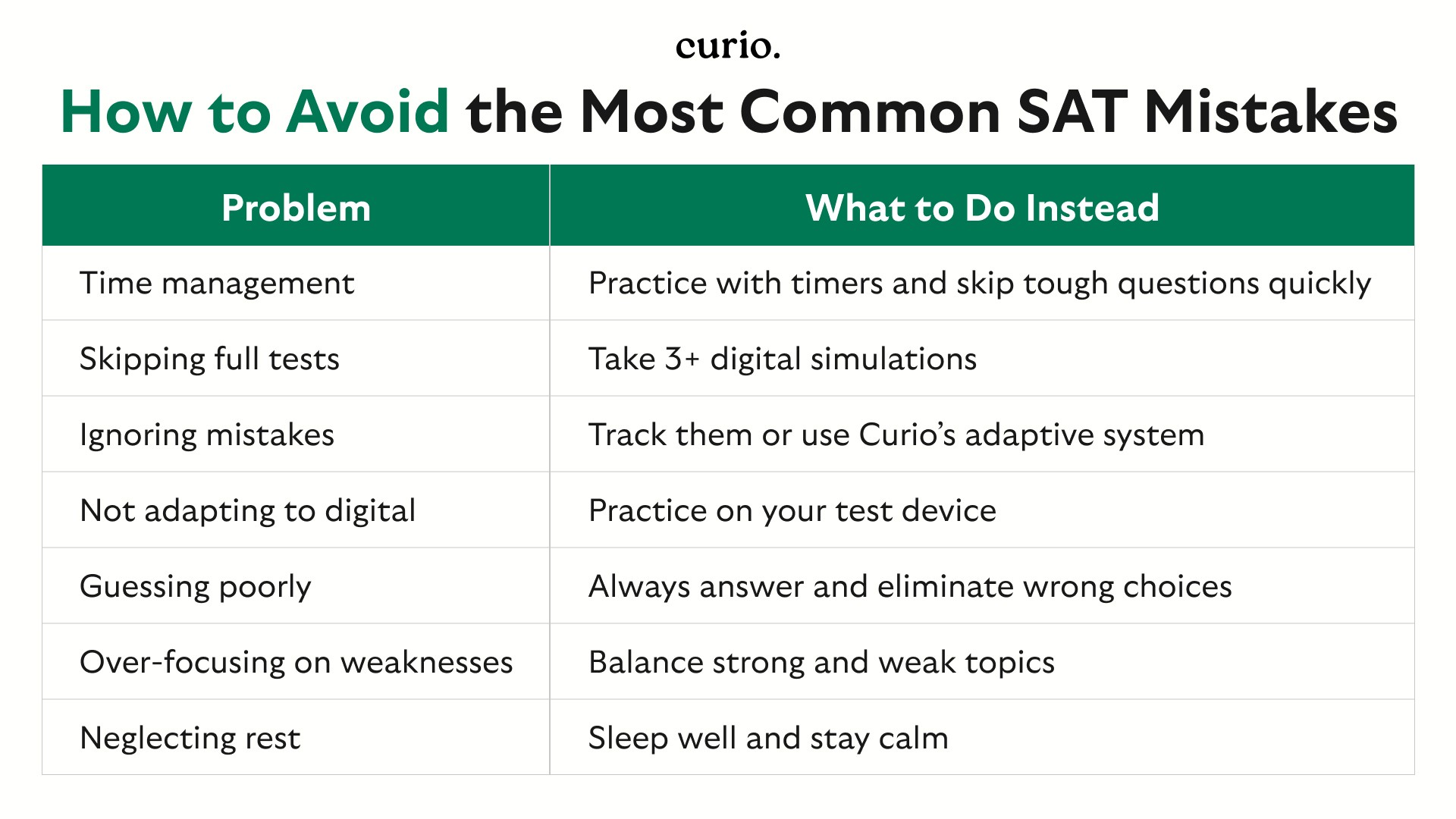
Every error you make during prep is an opportunity to grow. Instead of aiming for perfection, focus on building smarter study habits and self-awareness. With Curio’s adaptive SAT prep, every quiz and review session becomes personalized to your level. You’ll strengthen your weak areas faster, monitor your progress, and walk into the test center ready to perform at your best.
Frequently Asked Questions
What’s the most common SAT mistake?
Mismanaging time. Many students spend too long on early questions and rush the rest. Practice timed sections regularly.
What are the biggest digital SAT mistakes?
Not practicing on-screen, ignoring tools like highlighting, and failing to manage adaptive timing.
How can I stop repeating my SAT mistakes?
Keep an error log or use a tool like Curio that identifies patterns and gives personalized practice.
How can Curio help me improve faster?
Curio builds your Learning Profile, tracks progress, generates adaptive SAT-style questions, and updates your predicted score after every quiz.