Digital SAT Series
Nov 13, 2025
How the Digital SAT Is Scored (2025 Explained)

Why SAT Scoring Changed for the Digital Format
If you’re preparing for the Digital SAT, you’ve probably noticed that everything feels a little different: the questions are shorter, the test is faster, and the format is adaptive. But one of the most important changes is how the SAT is scored.
Understanding how the scoring system works helps you set smarter study goals and interpret your practice results accurately. Instead of guessing how many questions you can miss to reach a 1400, you’ll be able to plan your prep around the way the Digital SAT actually measures your ability.
If you’re not sure how to start, Curio can help you bridge that gap. It tracks how you perform on different question levels and shows how each quiz affects your projected score, so you can focus your prep where it matters most.
The Digital SAT, fully implemented in the United States by 2025, uses a multi-stage adaptive design. That means your score isn’t just about how many questions you get right, it also depends on the difficulty of the questions you answer.
The goal of the new scoring system is fairness and efficiency. Students no longer need to worry about a “bad section” ruining their score; instead, the adaptive structure quickly adjusts to their level, giving a more precise measurement of academic readiness.
How the Digital SAT Scoring System Works
The Digital SAT is divided into two main sections:
Reading and Writing
Math
Each section has two modules (Module 1 and Module 2). Everyone starts with a module of mixed difficulty, but what happens next depends on your performance.
Module 1: The Baseline
The first module for each section includes a balanced mix of easy, medium, and hard questions. Your performance here determines which version of Module 2 you’ll receive.
Module 2: The Adaptive Stage
If you do well on the first module, your second module will include more difficult questions. If you struggle on the first, your second will be slightly easier.
This is called adaptive testing, and it’s one of the biggest innovations in the Digital SAT. It allows the test to measure your true ability faster with fewer questions while maintaining the same accuracy as the paper version.
The Scoring Scale
The Digital SAT continues to use the familiar 1600-point scale, but how you reach that number has evolved.
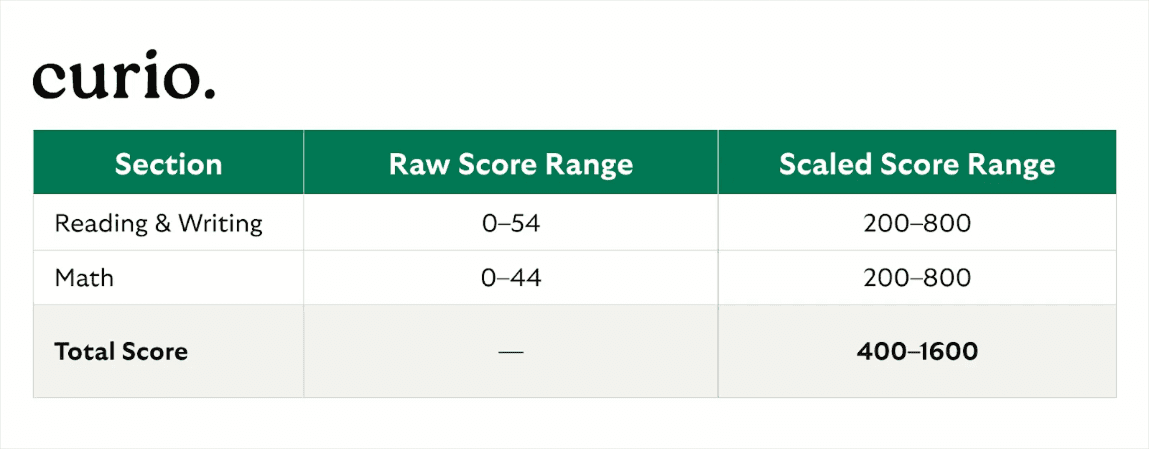
Your total SAT score is the sum of your two section scores. Each section starts at 200 and goes up to 800. The approximate question counts and scoring range align with official specifications. Minor variation in question count might occur.
From Raw Score to Scaled Score
Each question you answer correctly adds to your raw score (the total number of correct answers).
The College Board’s scoring system then converts your raw score to a scaled score using statistical models that account for question difficulty and adaptive performance.
This scaling ensures that a harder test version doesn’t unfairly lower your score, and an easier version doesn’t inflate it.
In short, the number of questions you answer correctly isn’t a direct indicator of your final score. Two students could get the same number of correct answers but different scores if one faced harder questions.
Adaptive Scoring in Action
Imagine two students, Alex and Maya.
Alex performs strongly on Module 1 of Reading & Writing, so Module 2 is more difficult.
Maya performs moderately, so Module 2 is easier.
At the end of the test, Alex answers fewer total questions correctly but scores higher because his questions were more challenging.
This is how adaptive scoring works. It rewards accuracy on difficult material and ensures that each test reflects the individual’s skill level, not just how many questions they answered correctly.
It’s the same reason adaptive prep tools like Curio are so effective. Curio’s SAT practice system mirrors this exact process, it adjusts to your strengths and weaknesses dynamically, giving you a realistic sense of your current score and where you need to improve.
Reading and Writing Scoring Breakdown
The Reading and Writing section includes both comprehension and grammar tasks. The two modules combined contain around 54 questions.
Key Details
Questions are short and focused, often tied to one or two sentences.
Each question is worth one raw point, whether it’s easy or hard.
The scaling algorithm accounts for the difficulty of the questions you received.
A student who gets 48 of 54 correct on a harder module could score higher than one who gets 50 on an easier module.
Math Scoring Breakdown
The Math section includes about 44 questions, divided across two modules.
You can use the built-in Desmos calculator for the entire section, another benefit of the digital format.
Like Reading and Writing, every correct answer adds to your raw score, and then it’s scaled.
Adaptive Math Modules
Since the Math section includes a mix of algebra, problem-solving, and geometry, the adaptive system ensures that higher performers get more complex, multi-step problems in their second module.
That means missing one or two hard questions won’t destroy your score, but consistent accuracy across both modules will raise it dramatically.
How Many Questions Can You Miss and Still Get a Good Score?
While the College Board doesn’t release exact score conversion charts for each test form, data from practice tests and Bluebook simulations give strong estimates.
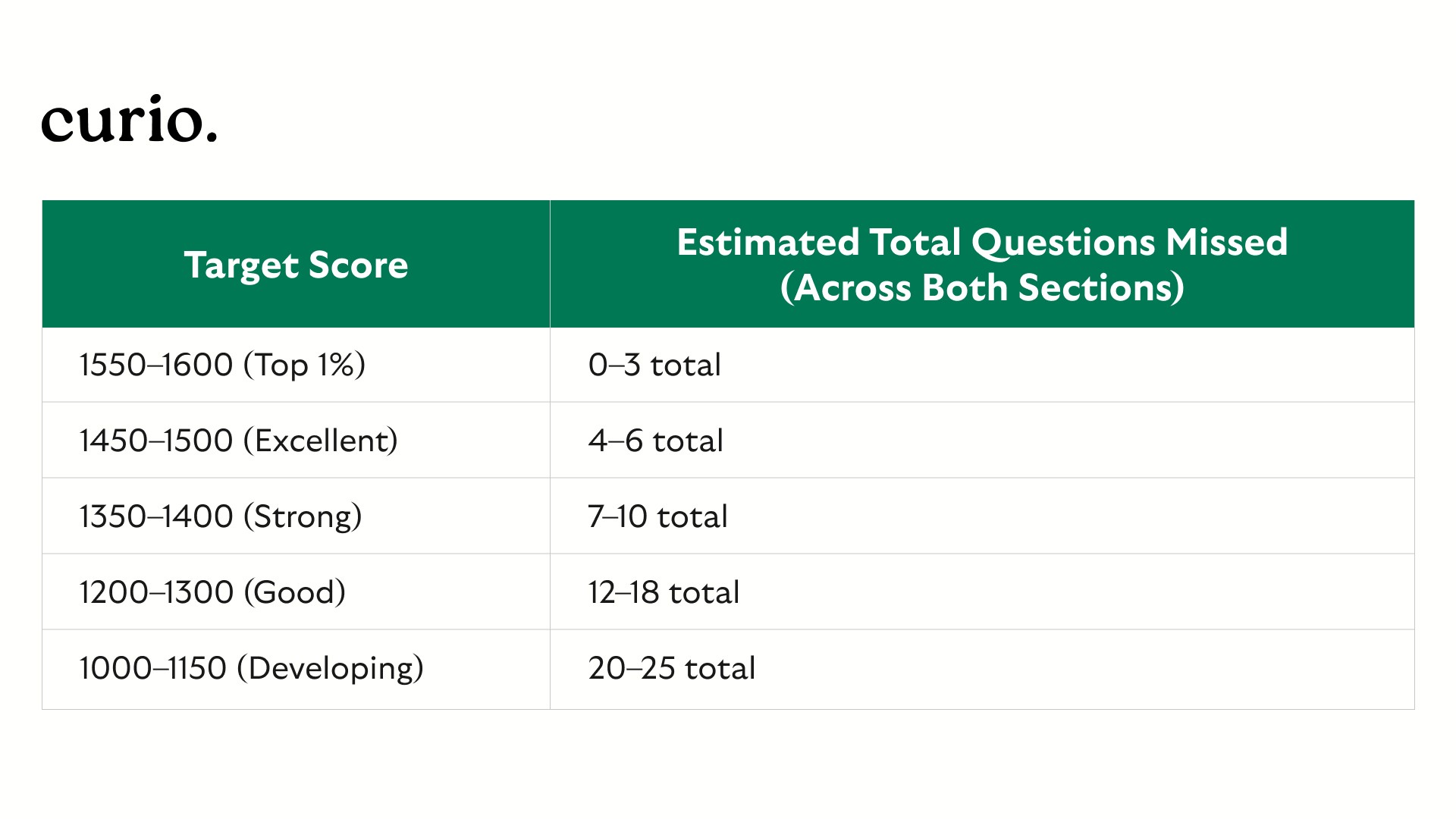
These numbers vary slightly based on question difficulty and module performance, but they provide a useful benchmark.
The main takeaway: the Digital SAT is more forgiving of small mistakes, especially if you’re tackling harder modules. Accuracy matters most on challenging questions, not perfection.
How Adaptive Scoring Affects Your Test Strategy
Adaptive scoring changes how you should approach the test.
Early Questions Matter
Your performance on Module 1 determines the difficulty of Module 2. Focus carefully on accuracy early, this sets your score ceiling for that section.
Don’t Panic Over Tough Questions
If you see hard problems in Module 2, that’s actually a good sign. It means you’re in the higher-scoring range. Even if you miss a few, your score potential remains strong.
Balance Speed and Accuracy
Because the Digital SAT is shorter (just over 2 hours), pacing is more important than ever. Practicing timed digital modules builds the mental rhythm you need.
Practice Adaptively
Studying in a static format doesn’t reflect how the real test works. Use adaptive tools like Curio, which automatically adjusts difficulty and tracks your simulated SAT score in real time. This helps you see how small gains translate into score improvements.
How Scores Are Reported
Your Digital SAT score report arrives within a few days after the test, much faster than the old paper version.
What Your Score Report Includes
Total Score (400–1600)
Section Scores (200–800 each)
Subscores for Reading and Writing categories (such as Craft and Structure or Expression of Ideas)
Percentile Ranking, comparing your score to other students nationally
These details help you identify which areas to strengthen before your next test date or college application deadline.
What Is a Good Digital SAT Score in 2025?
A “good” SAT score depends on your goals and target schools. Here’s a simplified breakdown.

These ranges reflect commonly accepted benchmarks but vary by institution. Remember that colleges look at more than test scores — your GPA, essays, and extracurriculars all matter. Still, a higher SAT score can strengthen your application and open scholarship opportunities.
When You’ll See Your Results
Digital scoring means faster turnaround times.
Typical Reporting Timeline
Scores are released within a few days after your test date.
You’ll receive them directly in your College Board account.
From there, you can send your scores to colleges or connect them to the BigFuture dashboard for college recommendations.
Common Misconceptions About SAT Scoring
“Harder Tests Mean Lower Scores.”
False. Adaptive scoring ensures fairness, you’re rewarded for tackling harder questions successfully.
“Everyone Gets the Same Questions.”
Not true. Each test adapts individually, but scaled scoring makes results consistent and comparable.
“You Need a Perfect Score to Impress Colleges.”
Also false. Even top universities admit students with a wide range of scores. Consistency, improvement, and strong academics matter most.
How to Track and Improve Your Score
Improvement starts with awareness. When you understand how your performance translates into points, you can focus your prep where it matters most.
Steps to Improve
✔️ Take a full-length digital practice test.
✔️ Note your raw scores per module.
✔️ Use an adaptive prep tool like Curio to simulate scaling and project your score.
✔️ Review weak areas, then retest after 1–2 weeks.
Why This Works
This method mirrors the real test’s adaptive logic. Over time, you’ll see how minor accuracy boosts or better pacing can raise your scaled score even without adding study hours.
Smarter Scoring, Smarter Prep
The Digital SAT brings precision, fairness, and adaptability to test scoring. Instead of punishing small mistakes, it evaluates your true ability through adaptive scoring.
For students, this means opportunity. The more you understand how the system works, the more strategically you can prepare.